Archive Page 32

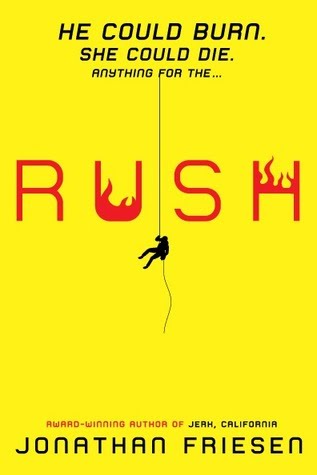
Rush by Jonathan Friesen

Genre:  Realistic Fiction

# of Pages:  295

RAC Book:  Yes

Jake King has always had a need for danger and excitement, but this need has gotten him into trouble on more than one occasion.  When his climbing antics actually injure an innocent bystander he is expelled from school.  At this point, he decides to join a very dangerous fire fighting troop in his town, but his next door neighbor and love interest does not like this idea because many young men have died mysteriously in this group.  Jake really feels fighting dangerous forest fires will be the only way he can keep himself from doing more crazy stunts in an attempt to clear his head.  Once he is training, however, he receives some stern warnings about one of the leaders and believes it is up to him to stop that leader from putting anyone else in danger.

Jake believes that he cannot think straight unless he is on an adrenaline high.  He also believes he has no fear of death, which is why he will not get involved with his next door neighbor whom he secretly loves.  Jake’s motivations and feelings are displayed clearly, but some of the back story is a little confusing at first.  It’s like stepping into a story where the characters have backgrounds that the reader is expected to know.  Some readers may be disappointed in the training and fire fighting scenes as well.  The book is advertised as being about someone who loves the adrenaline rush, but many of his death defying stunts are described quickly and fail to truly draw the reader in.  This book is still recommended for readers who like action and climbing books, but this is not the best one out there.

Manifest by Artist Arthur

Genre:  Fantasy

# of Pages:  248

RAC Book:  Yes

Krystal has recently moved to a new town due to her parent’s divorce and she is having trouble adjusting to her new life.  She has not made any friends, has stopped eating, and now has begun seeing ghosts.  Specifically, one ghost named Ricky has been following her.  He was a student at her school, but was shot and killed before she arrived.  Now he wants to find who really killed him so that he can cross over.  As Krystal copes with this difficult situation she meets two other students who mysteriously have the same birthmark as her.  They quickly realize that they all have special gifts and they plan to work together to find out what happened to Ricky.  They call themselves the Mystyx.  Despite Krystal’s hesitance to let others in on her secret, she finds relief when she can talk to her new friends about her supernatural visions.  Her relief is short lived, however, when she realizes that someone wants to hurt her for helping Ricky and the reasons behind his murder go deeper than she expected.

The plot of this story is interesting as Krystal tries to piece together what happened to Ricky.  The characters are interesting and well developed.  The writing style is a little simple and might turn off some young adult readers.  The beginning feels a bit slow and predictable, but once she meets her fellow mystyx things pick up quickly.  Fans of supernatural mysteries will enjoy this title, but it is not the best one out there right now.  Recommended to supplement a thriving fantasy collection.

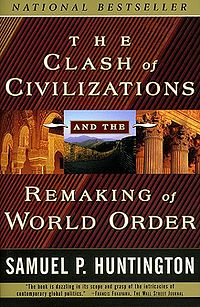
The Clash of Civilizations and Remaking of World Order by Samuel P. Huntington

** Student Review** by Tommy Blank

Genre:  Non-fiction, History

The Clash of Civilizations and the Remaking of World Order is a book that examines the cultures, viewpoints, and interactions between all cultures and religion in the world. It is a look at the world post cold war and post communism. The book examines prior relationships between cultures and makes predictions for relations in the future.  The author looks a lot at the interaction between Western Cultures and Muslim Eastern cultures.  He says cultures and religious differences will be the new source of conflict.  This book helped me understand more about world conflicts and how different cultures can cause conflict.   He breaks up the entire world into eight different civilizations and looks at how they interact. Samuel P. Huntington wrote this book in 1996 and he attended both the University of Harvard and Columbia.  The book is divided into five parts and the intended audience is those who possess a higher understanding of world politics and cultures.

Overall I found the book to be both boring and interesting. At times it was difficult to understand and comprehend. At times though the book was very interesting and informational.  I feel I have a broader and better understanding of world politics and how civilizations react.  However, this book was written almost 15 years ago before the War on Terror or 9/11 ever happened.  I think the book would have been very different if the author had written it now instead of 1996.  Huntington does do a very good job of explaining his thesis and providing facts to go along with it.  Unless you are looking for a detailed report on the world and cultures interacting, I would not recommend this book.  If you want a good book on world politics and world relations then I encourage you to read this book.  At times this book will be a hard read but if you stick with it, The Clash of Civilizations and the Remaking of World Order is a very interesting and captivating book.


The Republic by Plato, Translated by W.H.D. Rouse

**Student Review** by Caitlin Timmins

Genre:  Nonfiction

Written in 380 BCE by Plato, a forerunner of Western development, The Republic systematically loosens the ties binding man to his preconceived notions of justice and government. In doing so, the protagonist Socrates introduces ideologies that prove to play significant roles in philosophy thereafter. In a ten part chronicle, Socrates questions fellow Athenians on their stances regarding the function of morals, government, and the soul. Plato implements the Socratic Method in his writing, requiring critical thinking of the story’s characters as well as the reader. Readers approaching The Republic should understand that in order to thoroughly comprehend and appreciate the subject matter, they must continuously reassess their own viewpoints throughout the extensive logic-fueled debates.

Even clear wording is clouded by the complex concepts presented by this Socratic dialogue, yet Plato’s attention to detailed analysis manages to believably lead even Socrates’ most adamant opponents to eventually agree with his beliefs. Plato’s carefully conceived maze of logic and underlying bias will undoubtedly impress anyone interested in philosophy, debate, or human manipulation. Throughout the book, Socrates leads his associates through personal and moral evaluations, often arriving at surprising conclusions. Frequently however, such conclusions are not overtly stated or are refuted by seeming contradictions. Regardless, The Republic does an excellent job of appraising traditional institutions long before society began to question their value. Readers not deterred by the book’s considerable length or antiquated language will find themselves drawn into man’s timeless and insatiable quest for clarity.

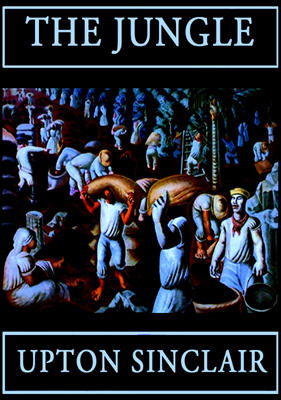
The Jungle by Upton Sinclair

**Student Review** by Gabby Bierlein

Genre:  Realistic Fiction

The Jungle is a novel about a Lithuanian family who moves to Chicago to work in the stockyards. It tells about their struggle for survival in this harsh new environment and the hardships that they must endure. Aside from this, The Jungle also gives an accurate description of the meat-packing industry in the early 1900’s and how life was for many new immigrants at that time. The author’s purpose for writing this book was to show the world how terrible an unskilled laborer’s life can be. After reading the book, however, the things that stuck with me the most were the atrocious conditions of the packing plants and how lax health standards were at that time. Thankfully, Upton Sinclair’s novel showed the world that something needed to be changed. Although The Jungle is almost 400 pages long, it does not get boring or old. The author keeps you reading with exciting twists and turns on every page. While some of the events that occur in the book are a little unbelievable, they add to the story and make it more interesting.
Overall, I thought this book was a very good read. Not only was it entertaining and interesting, it also taught me a lot about American history. It opened my eyes to the realization that life in a new country, especially one whose culture and language are unknown to you, can be extremely difficult. I would definitely recommend The Jungle to history fans and anyone who is looking for a good book. Although the book is long, and there are some slow parts, it is well worth the read.


Don Quixote by Miguel de Cervantes

**Student Review** by Chloe Hlas

Genre:  Historical Fiction

I think one of the main themes of this book was to poke fun at people who during the Renaissance, still believed in Middle Ages chivalry. The author basically murders the concept of knights displaying chivalry through Don Quixote’s hilariously ridiculous adventures. This book really helped me understand the Middle Ages mindset, and how the Renaissance evolved from it. Don Quixote’s incessant belief in all of the chivalrous concepts he’s read about in his old books brilliantly illustrates how people thought at the time, and how they themselves ridiculed anyone who had believed what they had once believed during the late Middle Ages, and on through the Renaissance.  This book was definitely worth reading to me, and significantly helped me in my studies of the late Middle Ages-Renaissance era. This book is designed to be humorous, yet informative at the same time to anyone learning about the mindset shift from late Middle Ages to Renaissance. It showed how people during the Renaissance time period reacted to fellow community members who believed in knights displaying a certain degree of chivalry.

This book was very useful to me, especially when studying the differences between the Middle Ages and the Renaissance (particularly the state of mind). It was amusing to read about all of Don Quixote’s adventures as he set out to save others and conquer evil, all in the name of his beloved lady, Dulcinea del Toboso. He devotes all of his actions to her, fighting windmills and saving princesses kidnapped by monks all in her name. I hadn’t expected Sancho to lie to Don Quixote and say that an evil enchanter has transformed his love, Dulcinea, into a peasant girl, which practically drives Don Quixote crazy as he strives to change her back. Sancho had been Don Quixote’s right hand man the whole book, and always tried to keep him out of ridiculous situations, and it shocked me that he would do something like that, which he knew would affect Don Quixote so deeply. However, it was hilarious to read about what the Duke and Duchess tell him would undo the hoax of Dulcinea’s enchantment. This was definitely a good book, and I certainly recommend it to anyone who enjoys books that mock historic time periods. I would’ve read this book on my own time, outside of class.


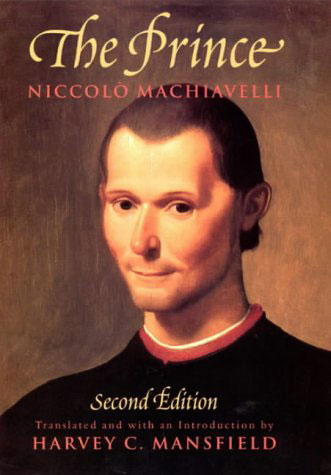
The Prince by Niccolo Machiavelli

**Student Review** by Charlie Schurman

Genre:  Non-fiction

Niccolo Machiavelli wrote The Prince as a dedication to Lorenzo di Piero de’ Medici, to gain the favor of the Medici, the ruling family of Florence, in the early 1500s. The Prince is a political treatise written in the style of a Mirror for Princes, detailing the ways a Prince ought to and not ought to act in both political and military matters. Machiavelli forms each chapter around a specific issue that a Prince (ruler) must deal with and provides specific and current (to the pre-Renaissance Italians) examples of other princes and how they dealt with the issues he asserts. Machiavelli goes into detail on these issues and specific examples by pointing out what these true to life princes either did correctly or incorrectly. Machiavelli closes each chapter with a brief summary of these issues and the way a Prince with virtue and skill would handle the situation. At the end of the book Machiavelli points specific current issues with Italy, and proposes a specific plan of how to make the Medici of Florence great, in hopes they would reward him for his genius. Some of Machiavelli’s suggestions, however, at the time seemed quite radical and his efforts to impress the Medici were in vain. The Prince is now renowned as one of the first pieces of modern philosophy, in which the effective truth is taken to be more important than any abstract ideal. Many of Machiavelli’s ideas are now quite common place in today’s political world, such as the ways a ruler must interact with his/her people, it is for these reasons that Niccolo Machiavelli and his work The Prince survive to the present day.

The Prince is a very interesting book, however it is a very dry read. For its purpose, which was to instruct the ruling powers of Italy during the 1500s, it exceeds in all areas, for entertainment value it gets a zero. The Prince reads more like a text book or a self help book more than anything else, outlining specific issues, giving examples, and showing solutions to problems. However, Machiavelli’s command of language and philosophy make it unusually clear and understandable for a five hundred year-old book on war and politics. It is unnaturally clear for a book of its type because Machiavelli spends much time dissecting each problem and providing a plethora of examples that both disprove and prove his theories. Machiavelli carefully weighs each and every solution against each other to find the clearest and most obvious solution to the problems he presents, even if it is not the easiest or most popular solution. Despite his lengthy discussions on certain topics, The Prince is a very quick read, only about one hundred pages long. For me this book was an inside look into the politics and thought of the Renaissance era, and was very intriguing. If you are a politics lover this book is a must, and if you are looking for a quick educational read give it a try, but if all you want is a good story, this book isn’t for you.


Discourse on the Methods by Rene Descartes


**Student Review by Fielding Montgomery**

Genre: Philosophy

In the book Discourse on the Method by Rene Descartes, Descartes writes about the method through which he claims to have proven the existence of God and make substantial advancements in all fields of study.  He describes his process in which he broke down all preexisting thoughts and biases he had and worked on individually reexamining these “truths” to try to discover what is really the truth.  He does this by sitting alone for long periods of time and conversing with his mind.  He lays out a lot of ground rules as to how you should act while using this method to develop your mind, comparing it a house.  He also mentions how this is something you can only do for yourself, you can’t force others to change their thoughts.  He first applies his method to algebra and geometry and has great success.  He later comes to the conclusion that the only thing he can truly prove is that “I’m thinking, therefore I exist.”  Because of this truth, he then decides that his mind must be separate from his body, helping him to prove the existence of God.  He does this by arguing that a perfect God cannot be imagined by an imperfect mind and through geometry.  He then goes on to discuss how he was going to put his work into a book but didn’t want to have controversy like Galileo did so he breaks it into essays.

This book is a very interesting read if you’re into philosophy.  It brings up interesting reasoning on many human things as well as the existence of God.  The quote “I’m thinking, therefore I exist,” is a very famous quote and very deep.  Decartes’s discussions with his mind provide a new way of thinking.  This book has a large vocabulary and is at times confusing to read.  Those who are not truly interested in philosophy will not appreciate this book.  Also, Descartes comes off as very arrogant in how he talks of himself, this could turn some away from the book.  Even through all this the philosophy and thinking is thought provoking.  This is definitely a suggested, short read.

-Fielding Montgomery


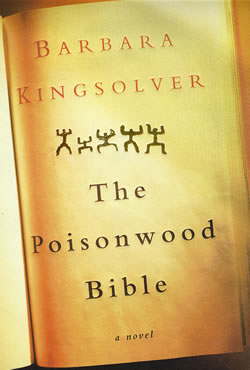
The Poisonwood Bible by Barbara Kingsolver

**Student Review** by Lauren Pyle

Genre: Historical Fiction

Told from five different points of view, The Poisonwood Bible incorporates the cultural arrogance of the United States with the ancient traditions of a Congolese village. During the 1950s, a radical Baptist minister, Nathan Price, brings his family to Africa in order to save the “unenlightened” souls of the Congolese. His four daughters, Rachel, Leah, Adah, and Ruth May, narrate the novel in the present tense with varying attitudes towards their new life. His wife, Orleanna, however, tells her side of the story as though grieving over past events, creating foreshadowing for the reader.

The oldest daughter, Rachel, is a materialistic teenager who hates her new life, while her younger sisters are excited, though each for their own reasons. Leah, for example, is overly enthused, like her father, at the prospect of welcoming more souls into their newly established Baptist church, while her twin sister Adah, a cripple and mute, silently observes her new surroundings with interest, though slightly detached from the rest of her family. The youngest Price daughter, Ruth May, quickly becomes friends with the children of the village and spends hours exploring the surrounding area.

The conversion of the villagers to the Baptist faith proves difficult, and Nathan Price faces many challenges in the old traditions and blasphemous (according to Reverent Price) rituals of the Congolese. He and the chief have several disagreements on the incorporation of Jesus into the Congolese faith. Meanwhile, the Price family begins to grow apart due to their varying faith convictions, and the headstrong Leah butts heads with her father over many issues. Amidst all these familial battles, the battle for the independence of the country is taking place, causing anxiety for the whole village. It appears as though the Price family, who hoped to stay in the country for at most a year, will have to stay longer due to tensions between the United States and the Congo. Dry spells, disease, violence, and the death of one of the Price family members threaten to widen the divide between the women of the Price family and Nathan Price.

This story is breathtakingly beautiful in its storytelling, and incorporates the many aspects of light versus dark, religious intolerance, familial relations and love, growing up, the ideas of individuality and true justice, as well as many other universal themes. Kingsolver creates many wonderful and three-dimensional characters for the reader to enjoy, including many villagers, a CIA operative pilot, a foulmouthed parrot, the six-toed religious leader of the village, and a young schoolteacher, with whom Leah falls in love. The story itself is a political allegory that focuses on the point the author wishes to make clear to all: the guilt that all citizens of the United States share when violence is done and they “sit passively by”. The author, Barbara Kingsolver, expertly handled the story’s plot and situation, almost as if she had been there herself (which she hadn’t). Personally, I loved the book, and it seems to be a feel-good story, in its own way. For those who didn’t like Cry, the Beloved Country, trust me, this is completely different (I would know, because I really didn’t like Cry, the Beloved Country). I would give this novel five stars, for sure, because it often made me close the book and think about our society today, and how we must respond to crises similar to the ones in this book. RECOMMENDED.
 

The World is Flat by Thomas Friedman

** Student Review** by Simon Sheaff

Genre:  Non-fiction

Any history textbook will tell you that in 1492 Columbus sailed the ocean blue, then Magellan made it all the way around, proving the world not flat, as was once believed, but round. This was a shocking discovery in 16th century Europe, but today, with satellite technology and intense physics, we can prove the world round in any number of ways.

So why would a book, written in the twenty-first century, when the roundness of the earth has been proven beyond doubt, be titled: “The World is Flat”?  And why, on earth, would it become a New York Times best-seller? Has the whole world gone mad?

The title is merely the beginning of a very compelling argument about what kind of a world we live in and how that world operates. Thomas L. Friedman, a Pulitzer Prize winning author and syndicated New York Times columnist, shows us through examples and reason how our world has been fundamentally changed. His basic argument is that we no longer live in a world where interaction is limited to those in your immediate vicinity. With the advent of the internet, cell phones, 3G, 4G, and cable television, our interactions are now unlimited and our business and personal relationships are long-distance by nature.  Our world, he argues, is fundamentally different from any other time in human history. We have changed the we do business, make friends, interact socially and so much more, using technology as our basis. Friedman refers to this as a leveling (or flattening) of the playing field known as geopolitics.

While the facts, reason, and examples are all interesting and convincing, this book may not appeal to the casual reader. It is not light-reading, but rather and in-depth and comprehensive piece of professional literature. It is not an everyday novel, but a case study of how the world around us is shaped.  This book has story-lines, plot and characters, but most only appear for a page or two and don’t compel the reader to read much further. If you are the type of reader, however, who enjoys learning as you read, or enjoys a fact-based and systematic approach to society, this book is one you should look more closely at. I immensely enjoyed it and hope others will too.

Happy reading,

Simon Phillip Thomas Sheaff

Confessions of the Sullivan Sisters by Natalie Standiford

Genre:  Realistic Fiction

# of Pages:  313

RAC Book:  Yes

The Sullivan family enjoys a nice lifestyle living in a big house with a very prestigious reputation.  Their grandmother is nicknamed Almighty because she has so much influence in society.  On Christmas Day Almighty announces that one member of the Sullivan family has offended her and the entire family will be cut off financially if that person does not confess.  The three teenage girls immediately write confessions and deliver them to Almighty on New Year’s Eve.  They all three believe they were the ones to offend Almighty and put their family’s future in jeopardy.  What would you be willing to admit if your financial security depended on it?

This story is very interesting as the three confessions weave together and the reader tries to figure out who was the person who actually offended Almighty.  The characters are well written and easy to identify with, which makes it easier to care about what happens to this family.  The Sullivan parents are vapid and uninvolved, but the kids are all unique and have a healthy dynamic with each other.  The ending is satisfying, but it’s the confessions that will interest readers the most as these girls admit what they have done without thinking about how these actions could influence the family.   Recommended.

Three Black Swans by Caroline B. Cooney

Genre:  Realistic Fiction

# of Pages:  276

RAC Book:  Yes

Missy and Claire are cousins who are extremely close.  They have sleepovers every weekend and talk to each other constantly.  They also have a strong “family resemblance” that their parents are always trying to explain away.  Missy is two months younger and until recently was always smaller than Claire so she never let herself believe they might be more than cousins, but one day she realizes that the resemblance is too much to be ignored.  She convinces Claire to come on the morning announcements show at Missy’s school to pretend to be long lost identical twins. She tells Claire it will be an elaborate hoax, but she really believes it will force everyone to face the situation.  The problem is that when the video goes viral on the Internet another girl comes forward who looks just like them too.  Who is she and how did they get separated?

Fans of Caroline B. Cooney will enjoy this story as the lives of three young girls find themselves intertwined.  Many questions arise such as who are their real parents? Why have they been lied to this whole time?  Are they really sisters?  The three girls are entertaining and easy to identify with, but the three sets of parents are characterized well too and their motivations for questionable actions ring true.  The ending was satisfying and will leave readers wanting to read more titles by Cooney.

Stork by Wendy Delsol

Genre:  Fantasy

# of Pages 357

RAC Book:  Yes


Katla is having a difficult time adjusting to Minnesota after living in California her entire life.  Her parents’ recent divorce is difficult to adjust to as well.  When she learns that she is a member of a secret stork society she realizes her return to her mother’s home town may not be accidental after all.  Kat is supposed to help babies find their destined mothers through the help of the stork society and her own visions.  Meanwhile, she learns she had a traumatic episode involving a local boy, Jack, when she was younger that she blocked out.  She feels a strong connection to Jack and does not know if it is because of their near death experience as children or because of her affiliation with the storks.  Can she find her place in this new and mysterious town in Minnesota?

The premise behind this story is very intriguing as Katla navigates her skills as a stork, but this aspect of the book is not explored as much as it could and should have been.  The majority of the plot focuses on Jack and Kat’s relationship, which has some mystery and intrigue.  Readers who enjoy folklore will find their romance interesting, but there are many predictable aspects due to the overwhelming foreshadowing.  The ending is exciting, but everything is wrapped up too quickly and some readers might get confused about the plethora of information revealed in the last 20 pages.  Fans of the Twilight series would be the target audience for this title.

The Scorch Trials by James Dashner

Genre:  Adventure/Futuristic Fiction

# of Pages:  360

RAC Book:  Yes

In this sequel to The Maze Runner, Thomas and his friends are hoping their trials are over.  Unfortunately, this is just the beginning of another round of trials.  They must face scorching heat, disease, and even opponents with weapons.  Plus, a lot of their actions seem to be predetermined somehow.  A lot is revealed about Thomas’s past and the reasons behind the trials, but these answers simply bring up more questions.  Will Thomas and his friends survive to find out why they are being forced into such terrible tests?  Will they ever know whom they can truly trust in this crazy experiment?

The sequel does not provide as interesting of a backdrop as the maze did, but the twists and turns of the plot will keep fans interested.  The characters become more endearing throughout this story also because we know how far they have come and realize they still have a long ways to go to enjoy freedom.  Many new characters are introduced and their motives are murky at best, which keeps the characters and the reader guessing.  All in all, it is not as enticing as the first one, but will definitely keep young readers interested.

Blood On My Hands by Todd Strasser

Genre:  Realistic Fiction/Mystery

# of Pages:  274

RAC Book:  Yes

Cally is horrified when she finds her best friend’s body bloody and unresponsive at a party.  She tries to find signs of life, but only comes to the shocking realization that she has been stabbed to death.  To make matters worse, some other students see her with the body and take her picture holding the murder weapon.  Feeling like she has no other choice, Cally runs for her life and hopes she can find some evidence that can prove her innocence.

Todd Strasser has written many books that students can identify with and this one is no exception.  Touching on themes such as bullying, dating, domestic violence, and deployment this book faces several tough issues head on.  At the same time, Cally is trying to piece together what actually happened that fateful night and wonders how she can escape the same terrible fate that befell her brother.  A very exciting read.


Archives


Design a site like this with WordPress.com
Get started